


Viva Raw vs. Kibble, a Side by Side Review
Raw pet food is a complete diet built from uncooked meat, organs, and ground bone, balanced to meet established nutrient profiles without the high heat that produces dry kibble.
Viva Raw is one example, a subscription brand that makes frozen, AAFCO-formulated raw meals for both dogs and cats.
This raw pet food vs kibble comparison measures Viva Raw’s frozen raw formulas against a representative standard dry kibble using only publicly documented product specifications, with every source named for you to check.
This Viva Raw pet food versus standard kibble ingredient comparison works through seven side-by-side dimensions, from primary protein source and meat content to moisture, additives, and cost per day.
Table of Contents
- Which Line Is Right For You?
- How We Ran This Comparison
- Nutritional Macros at a Glance
- Pros and Cons
- The 7-Point Comparison: Viva Raw vs Standard Kibble
- The Full Side-by-Side (Use This to Verify)
- Frequently Asked Questions
The line centers on five single-protein recipes, chicken, turkey, beef, duck, and rabbit, built around humanely raised, USDA-inspected meat sourced from certified family farms, with a seasonal venison option rotating in.
For dogs, the recipes fold in organic natural supplements alongside green-lipped mussels and shiitake mushrooms for added bioavailability.
For cats, the formulas go animal-based and species-appropriate, roughly 97 to 98% meat, organs, and bone with 2 to 3% natural supplements, and no vegetables or starchy fillers.
Everything arrives frozen to your door in eco-friendly coolers, on subscription or as a one-time order.
Which Line Is Right For You?
- If you’re managing a food-sensitive dog, the single-protein recipes make elimination diets straightforward.
- If you have a cat, the near-total-meat formulas lean hard into obligate-carnivore nutrition.
Either way, the question this review answers is narrower: How does what’s in the bag actually compare to standard kibble?
“I feel the quality of this food is amazing. I do have a senior cat who’s been on commercial kibble most of her life. So, this transition is very challenging. I’m able to get her to eat some in the morning but the rest of the day she will just refuse to eat and yes I’ve done the whole transition very slowly. One step at a time :-)” – Samantha Jasmer, Verified
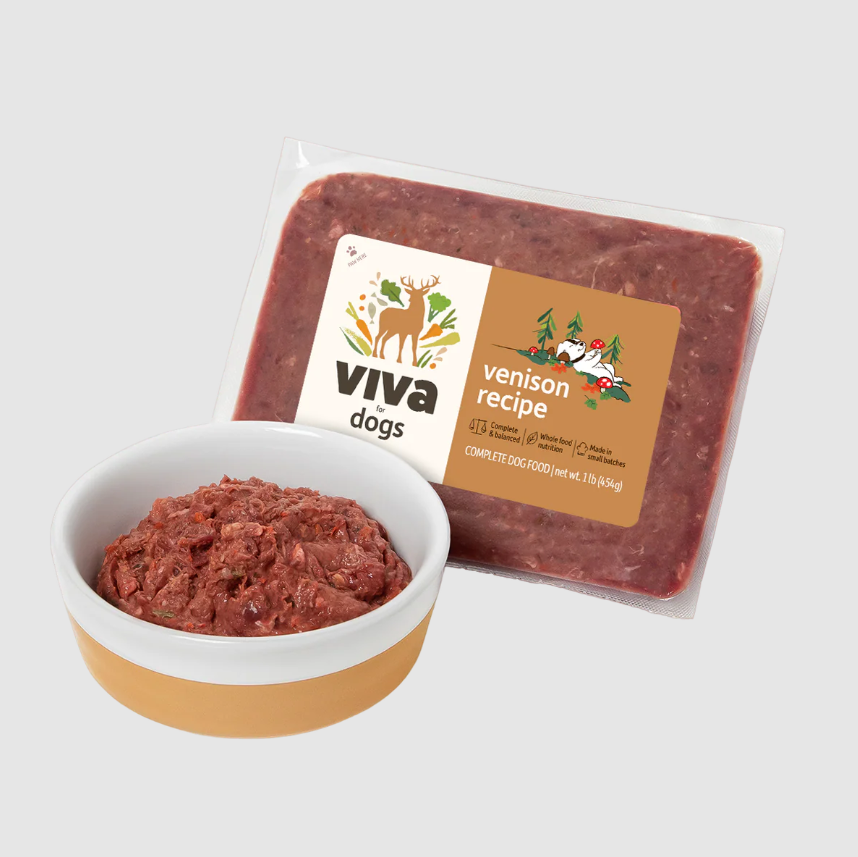
Viva Raw Venison is a favourite flavour for dogs!
Image source: Viva Raw (attribution inferred from the post).
How We Ran This Comparison
A comparison is only as trustworthy as its method. Here’s ours, stated plainly so you can hold it to account.
- Documented specs only. Every figure comes from a published ingredient list, guaranteed-analysis panel, or third-party lab-referenced review, never from a slogan or marketing page.
- Representative kibble, named. We use Purina Dog Chow Complete Adult and Purina Cat Chow Complete for ingredient composition (archetypal grocery-aisle kibble) and Hill’s Science Diet for premium per-day pricing, so the cost comparison is premium-to-premium and fair.
- Ingredients read in order. AAFCO requires ingredients to be listed by pre-cooking weight, so the first few entries tell you what a food is mostly made of. We read them that way.
- Sources listed. Every source appears at the end for independent checking.
With that standard set, here are the seven dimensions, the heart of this raw dog food vs dry food comparison and its feline counterpart.
Nutritional Macros at a Glance
Before the dimension-by-dimension breakdown, here’s the documented macro snapshot, the numbers that anchor everything below.
- Viva Raw (cat): ~59–65% protein on a dry-matter basis, 73% moisture as-fed, ~97% meat/organ/bone (independent review + product pages).
- Purina Cat Chow Complete: ~36% protein on a dry-matter basis; corn- and by-product-meal-led ingredient deck.
- Purina Dog Chow Complete Adult: 21% crude protein (min), 10% fat (min), 12% moisture (max) as-fed.
- Hill’s Science Diet Adult (premium kibble): 20% crude protein (min), 11.5% fat (min), 365 kcal per 8-oz cup.
Pros and Cons
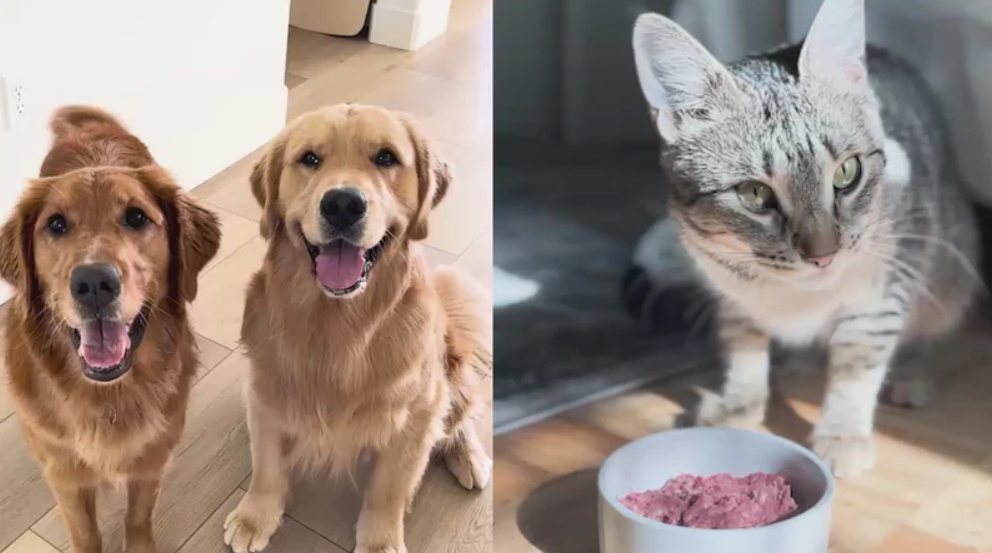
Image source: Viva Raw (attribution inferred from the post).
Every food is a set of trade-offs. Here’s Viva Raw’s, drawn only from documented specifications rather than brand messaging.
| Strengths | Trade-offs | Worth Knowing |
| Whole-meat first ingredient; ~97% meat for cats | Costs several times more per day than kibble | The price gap is the central trade-off, quantified in Dimension 7 |
| No grains, corn, or starchy fillers; no artificial colors | Requires freezer space plus thaw and safe handling | Frozen delivery in eco-coolers; ships to all 50 U.S. states |
| 71–73% moisture supports feline hydration | AAFCO adequacy by formulation, not feeding trial | Same substantiation method as the representative kibbles |
In short, Viva Raw trades convenience and cost for ingredient quality and moisture. Whether that trade is worth it is exactly what the seven dimensions below quantify.
The 7-Point Comparison: Viva Raw vs Standard Kibble
Here’s the Viva Raw vs kibble breakdown, one documented dimension at a time. Each point compares what’s actually printed on the label.
1. Primary Protein Source
The first ingredient on a label is the single biggest tell, because AAFCO lists ingredients by weight. On Viva Raw’s Beef for Cats recipe, that first ingredient is simply Beef, whole muscle meat, followed by beef heart, bone, liver, and kidney.
All of it is humanely raised and USDA-inspected, with no hormones or growth-promoting antibiotics.
Now the kibble. Purina Dog Chow Complete Adult opens with whole grain corn, then meat and bone meal and corn gluten meal. Purina Cat Chow Complete leads with chicken by-product meal, then ground yellow corn and corn gluten meal.
The representative kibble’s primary ingredient is either a grain or a rendered meal, not fresh, named muscle meat.
- Viva Raw (cat): First ingredient = named muscle meat (e.g., Beef)
- Dog Chow: First ingredient = whole grain corn
- Cat Chow: First ingredient = chicken by-product meal (a rendered by-product)
- Documented difference: Fresh named meat vs rendered meal or grain
For a raw cat food vs kibble shopper, this is the starkest line on the label.
“I recently transitioned my cat to Viva Raw and the process was much easier than I expected. The food is high quality, arrives well packaged, and has stayed fresh throughout. My cat took to it quickly and got excited every mealtime. I also appreciate the simple ingredient list and the variety of protein options. Ordering and shipping have both been smooth, and the overall experience has been excellent. If you’re considering a raw diet for your pet, I’d definitely recommend giving Viva Raw a try.” – Josh Gandara, Verified
2. Meat Content Percentage
Viva Raw documents a 97% meat, organ, and bone formulation for its cat recipes (3% natural supplements). That figure is printed on the product page for each recipe.
Standard kibble, tellingly, doesn’t publish a meat percentage at all, and that absence is itself a finding.
Using standard pet-food formulation methodology, you estimate it from ingredient order.
When corn, corn gluten meal, and wheat occupy the top of the deck and animal protein appears as a single rendered meal, the actual meat fraction sits well below a raw diet’s.
The practice of ingredient splitting, listing ‘corn’ and ‘corn gluten meal’ separately so each weighs less than the meat, can further disguise how grain-heavy a formula really is.
- Viva Raw (cat): 97% meat/organ/bone (documented on product page)
- Representative kibble: no published meat %; grain-led ingredient deck
- Methodology: ingredients ranked by pre-cooking weight; watch for split grains
When a brand won’t put a meat number on the label, the label order is the next best evidence, and it favors raw in this fresh raw vs processed pet food matchup.
3. Starchy Filler Content
Viva Raw’s cat formulas carry no grains, corn, potato, or legume fillers, the recipes are meat, organ, bone, and a short list of whole-food supplements (organic psyllium husk provides fiber, there’s no starch base).
For dogs, the same no-grain, no-starchy-filler approach holds. The representative kibbles are built on the opposite premise.
- Dog Chow lists whole grain corn, corn gluten meal, soybean meal, and whole grain wheat among its leading ingredients.
- Cat Chow stacks ground yellow corn, corn gluten meal, whole grain wheat, rice, and soy flour.
These starches are the structural backbone that lets kibble hold its shape, which is precisely why they’re there in volume.
- Viva Raw: No grain, corn, potato, legume fillers
- Dog Chow: Corn, corn gluten meal, soybean meal, wheat in top ingredients
- Cat Chow: Corn, corn gluten meal, wheat, rice, soy in top ingredients
For anyone running a raw dog food vs dry food comparison around food sensitivities, this is the dimension that matters most.
4. Moisture Content
This one carries real clinical weight, especially for cats. An independent, lab-referenced review documents Viva Raw’s cat formulas at 71–73% moisture, close to the water content of fresh prey.
A representative dry kibble, by its own guaranteed analysis, lists moisture at a maximum of ~12% (Dog Chow’s panel states 12% max).
Why it matters: cats evolved as desert animals with a low thirst drive, and veterinary nutrition literature links higher dietary moisture to more dilute urine and better lower-urinary-tract health, a documented concern for cats fed exclusively dry diets.
A high-moisture bowl does some of the hydrating that a kibble-fed cat otherwise has to do at the water dish, and often doesn’t.
- Viva Raw (cat): 71–73% moisture, as-fed (independent review)
- Representative kibble: ~10–12% moisture max (guaranteed analysis)
- Clinical note: dietary moisture supports feline urinary-tract health
In a raw cat food vs kibble decision, moisture may be the single most consequential number on this list.
5. Additive & Preservative Content
Because raw food isn’t cooked at high heat, Viva Raw relies mostly on whole-food supplements to round out nutrition: mussels, oyster meat, cod liver oil, organic Icelandic kelp, nutritional yeast, and in the dog line, shiitake mushrooms, plus targeted additions like taurine for cats.
There are no artificial colors on the label.
Heat-processed kibble tells a different story. Cooking destroys nutrients, so adequacy is rebuilt with a long synthetic vitamin-and-mineral premix, zinc sulfate, ferrous sulfate, copper sulfate, menadione sodium bisulfite, and a dozen more.
The representative kibbles also carry artificial colors (Dog Chow lists Yellow 6, Yellow 5, Red 40, and Blue 2; Cat Chow lists Red 40, Yellow 5, Blue 2), cosmetic dyes that serve the human shopper, not the pet.
- Viva Raw: whole-food supplements (mussels, kelp, cod liver oil, shiitake), no artificial colors
- Kibble: Synthetic vitamin/mineral premix to replace heat-lost nutrients, artificial colors (Yellow 6/5, Red 40, Blue 2) documented on labels
Both foods are nutritionally complete but they get there by very different routes, and only one adds dye for looks.
6. AAFCO Formulation Basis
Here’s where we resist the easy narrative. AAFCO adequacy can be substantiated two ways:
- By formulation: The recipe is calculated to meet nutrient profiles
- By feeding trials: Animals are actually fed the food and monitored
Viva Raw’s cat recipes state they are ‘formulated to meet the nutritional levels established by the AAFCO Cat Food Nutrient Profiles for All Life Stages.’
And the representative kibbles? Dog Chow Complete Adult is also formulation-based, its label reads ‘formulated to meet… AAFCO… for maintenance of adult dogs.’ So on method, these products are even.
The documented differences are scope and substantiation: Viva Raw certifies for All Life Stages (the higher bar, covering growth and reproduction), while Dog Chow certifies for adult maintenance only.
Some premium brands go further and run feeding trials, the more rigorous route, so a fully informed shopper should weigh that, too.
- Viva Raw (cat): formulation-based, All Life Stages
- Dog Chow: formulation-based, adult maintenance only
- Feeding trials: an alternative, more rigorous substantiation used by some premium brands
This is the one dimension where kibble and raw stand on equal method, an honest Viva Raw vs kibble review has to say so.
7. Price Per Day of Feeding
No comparison is complete without the number that stops most people: cost. Viva Raw documents about $2.50 per day for a 10-lb cat, with per-pound prices from $6.75 (chicken) to $10.50–$11.25 (rabbit).
For dogs, published pricing runs $6–$10.75 per pound; fed at the standard raw guideline of ~2–3% of body weight daily, a 30-lb dog lands near $6 per day and a 50-lb dog closer to $10.
Now premium kibble. Hill’s Science Diet Adult runs $86.99 for a 35-lb bag ($2.49/lb); at its feeding guide (~3¼ cups for a 50-lb dog), that’s roughly $1.30–$1.90 per day for a 30–50-lb dog, and premium cat kibble typically lands well under $1/day.
The documented conclusion is unambiguous: raw costs several times more per day than kibble.
That’s the trade-off in exchange for the ingredient and moisture differences above, and this review won’t pretend otherwise.
- Viva Raw: ~$2.50/day (10-lb cat); ~$6–$10/day (30–50-lb dog)
- Premium kibble (Hill’s): ~$1.30–$1.90/day (30–50-lb dog); cat well under $1/day
- Methodology: raw per-day = published $/lb × 2–3% body-weight feeding guideline; kibble per-day = bag price × feeding-guide cups
The fresh raw vs processed pet food decision ultimately comes down to this line, and to whether the guarantee below lets you test the difference before committing.
The Full Side-by-Side (Use This to Verify)
Everything above condenses into one table, built for independent verification. Each row is a documented specification you can check against the sources listed at the end, a raw pet food side by side review you can audit line by line.
What the table shows: the documented specification for each dimension, raw vs kibble, with no interpretation added.
| Dimension | Viva Raw (documented) | Standard Kibble (documented) |
| 1. First ingredient | Named muscle meat (e.g., Beef) | Whole grain corn (Dog Chow) / chicken by-product meal (Cat Chow) |
| 2. Meat content | 97% meat/organ/bone (cat) | Not published; grain-led deck |
| 3. Starchy fillers | None (no grain/corn/potato/legume) | Corn, corn gluten meal, wheat, rice, soy |
| 4. Moisture | 71–73% (as-fed) | ~10–12% max |
| 5. Additives | Whole-food supplements; no artificial color | Synthetic vitamin/mineral premix; artificial colors |
| 6. AAFCO basis | Formulation; All Life Stages | Formulation; adult maintenance |
| 7. Cost per day | ~$2.50 (10-lb cat); ~$6–$10 (dog) | Cat under $1; dog ~$1.30–$1.90 |
Note: One caveat, stated in the same spirit as the rest of this review: these conclusions are only as reliable as the documentation behind them. Ingredient lists and prices change.
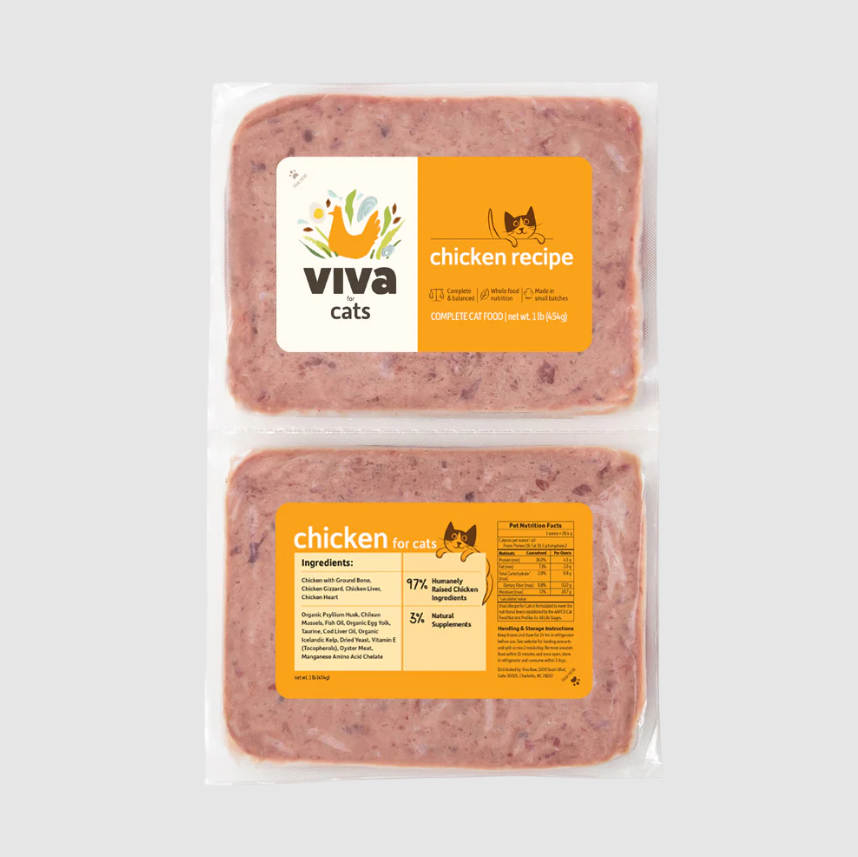
A favourite for cats is the Viva raw chicken flavour.
Image source: Viva Raw (attribution inferred from the post).
Frequently Asked Questions
What makes Viva Raw different from standard kibble?
The label. Viva Raw leads with named muscle meat, documents ~97% meat for cats, carries no starchy fillers, and runs 71–73% moisture, versus a representative kibble’s grain- or by-product-meal-first deck, ~12% moisture, and synthetic-premix nutrition.
- Named meat vs grain / rendered-meal first ingredient
- 97% meat (cat) vs undisclosed meat %
- 71–73% moisture vs ~12% max
- Whole-food supplements vs synthetic premix plus dyes
Is raw cat food safe and complete?
Viva Raw’s cat recipes are formulated to meet AAFCO Cat Food Nutrient Profiles for All Life Stages, use USDA-inspected meat, and are tested for pathogens (Salmonella, E. coli, Listeria) per an independent review. As with any raw food, standard safe-handling and thawing practices apply.
Why is raw so much more expensive per day?
You’re paying for fresh, USDA-inspected muscle meat and organs at roughly 97% of the recipe, rather than grain fillers that cost a fraction as much. The per-day math, about $2.50 for a 10-lb cat versus under $1 for premium cat kibble, reflects that ingredient gap directly.