


Best Pet Insurance Plans Reviewed and Compared
Pet insurance ranks among the most difficult financial products for consumers to compare accurately. Marketing language across plans sounds nearly identical, and the exclusions that matter most are buried in policy documents.
The differences that most determine whether a plan pays well are the ones least prominently advertised.
This guide identifies seven specific, independently verifiable quality markers that the best pet insurance plans share, with step-by-step guidance on how to check each one before purchasing.
Whether you are searching for how to choose pet insurance Canada, building a pet insurance checklist Montreal, or evaluating your first plan, this framework applies to every policy you consider.
You will learn exactly what to look for in policy terms before signing up, which is far better than relying on a simple star rating.
Each of the seven markers in this article includes a specific verification method to ensure you can confidently verify pet insurance coverage.
Table of Contents
- What Separates the Best Plans From the Rest
- Pros and Cons of Spot Pet Insurance
- Spot Pet Insurance Ratings Breakdown
- Feature Comparison Spot Pet Insurance vs Competitors
- 7 Quality Markers Every Plan Should Pass
- What Pet Insurance Plans Typically Exclude
- Evaluating the Value of Pet Insurance
- Frequently Asked Questions
What Separates the Best Plans From the Rest
Comparing pet insurance policies is notoriously difficult because summary pages rarely reveal structural limitations. Marketing promises like comprehensive coverage and fast reimbursement sound great, but the true value lies in the fine print.
Pet insurance what to look for always comes down to the actual policy document rather than the glossy brochure.
A pet parent who understands what to look for in policy terms is far better protected.
Unlike evaluating a consumer product where physical features are visible, pet insurance quality is entirely determined by written stipulations.
Spot Pet Insurance serves as the benchmark plan throughout this article precisely because each feature discussed, from Spot Pet Insurance verified coverage for cats and dogs to the reimbursement calculations, can be independently verified in its policy documentation.
This is the exact same standard every reader should apply to any provider they evaluate.
Every quality marker detailed in this guide includes a specific verification method. You will learn exactly which section of the policy document to locate, a calculation to run, or a source to consult independently.
This ensures you base your financial decisions on hard facts rather than advertising claims.
Trustpilot Review, 5 stars
“When our dog needed emergency surgery, I was terrified about the cost. Spot processed our claim in just 3 days and reimbursed 90% of the $4,200 vet bill. The claim submission through their app was incredibly easy—I just took a photo of the invoice. I can’t recommend Spot enough for pet parents who want real financial protection.” – Jennifer M., California
| Key Insight: Pet insurance quality is determined by the policy document, not marketing. The most reliable plans, like Spot, offer verifiable terms that eliminate network restrictions and coverage caps, ensuring predictable protection when it matters most. |
Pros and Cons of Spot Pet Insurance
Protect your pet, Get Spot!
Before working through the seven quality markers in detail, it is worth establishing a clear snapshot of how Spot Pet Insurance performs against each one.
The table below maps documented plan features to specific strengths, alongside an area where prospective buyers should read policy terms carefully.
This structured review highlights feature-level transparency rather than star ratings in isolation.
Every quality marker corresponds to a documented plan feature that can be confirmed in Spot’s policy terms. Readers evaluating other providers should apply the same table-level scrutiny, checking each feature against the actual policy document.
Coverage, waiting periods, deductibles, annual limits, exclusions, and pre-existing condition rules vary by plan and state, so always review policy details before purchasing.
| Feature or Aspect | Pro or Con | Explanation |
| Vet network policy | Pro | Any licensed vet in the U.S. or Canada; no network restrictions documented in plan terms. |
| Reimbursement rate ceiling | Pro | Up to 90% cash back on covered vet bills; reimbursement rate is customizable at enrollment. |
| Hereditary and dental | Pro | Plan terms document coverage for hereditary, congenital, chronic, and dental illness conditions. |
| Lifetime cap structure | Pro | No lifetime caps documented; annual limits reset each policy year. |
| Verified review volume | Pro | 8,300+ verified reviews with a strong long-term reviewer base; independently checkable. |
| 24/7 telehealth access | Pro | 24/7 pet health helpline included as a documented plan benefit, not a paid add-on. |
| Trial period and cancellation | Pro | 30-day money-back guarantee documented; refund available if no covered expenses applied. |
| Prescription medications | Consideration | Some reviewers note limitations on coverage for ongoing prescription medications; read policy terms. |
| Pro Tip: When comparing plans, prioritize a “no network restriction” policy above all. This single feature guarantees your emergency care choices are never limited, which is critical during a pet health crisis. |
Spot Pet Insurance Ratings Breakdown
The following ratings assess Spot Pet Insurance across six categories that map directly to the seven quality markers this article examines.
Each category is scored based on documented plan features, verified reviewer feedback, and structural policy analysis.
Ratings are intended to help readers calibrate how Spot performs relative to what the best pet insurance plans should offer.
| Rating Category | Score |
|---|---|
| Vet Network Flexibility | 9.5/10 |
| Reimbursement Rate Structure | 9/10 |
| Hereditary Dental and Behavioral Coverage | 9/10 |
| Annual Limit and Lifetime Cap Structure | 9.5/10 |
| Verified Review Volume and Recency | 8.5/10 |
| Value for Coverage Relative to Premium | 9/10 |
Vet Network Flexibility
One of the most consequential decisions in a pet insurance policy is whether members can visit any licensed veterinarian or are restricted to a specific network.
Plans with network restrictions create friction at exactly the worst moment when a pet is injured and the nearest emergency clinic is out-of-network.
Spot’s documented plan terms specify that members can visit any licensed vet in the United States or Canada.
This is the standard all plans should be held to, and it is verifiable by checking the Eligible Providers section of any policy document.
- No network restrictions documented in Spot’s plan terms.
- Coverage applies to any licensed vet in the U.S. or Canada.
- Verification method: Check the Eligible Providers section of the policy document.
- Highly relevant for Canadian pet owners and Montreal residents.
Reimbursement Rate Structure
The reimbursement rate is the percentage of a covered vet bill a plan pays back after the deductible is met. Plans advertising up to 90% reimbursement without clarifying how the calculation works can create unrealistic expectations.
Spot offers reimbursement options up to 90% on covered vet bills with a straightforward structure.
After the annual deductible is satisfied, the plan reimburses the selected percentage of eligible covered costs up to the chosen annual limit.
- Reimbursement rates up to 90% on covered vet bills available with Spot.
- Rate is customizable at enrollment rather than a fixed percentage.
- Deductible must be met before reimbursement applies.
- Annual limit caps total reimbursement for the policy year.
Trustpilot Review, 5 stars
“Spot’s customer service team went above and beyond when my dog was diagnosed with cancer. They walked me through which treatments were covered, helped me understand my reimbursement timeline, and even checked in to see how my dog was doing. During the most stressful time, they made the insurance process easy. That level of care means everything.” – Kate R., Florida
Hereditary Dental and Behavioral Coverage
Many pet insurance plans include broad language about illness coverage while quietly excluding hereditary conditions, dental illnesses, and behavioral issues.
These exclusions are rarely featured in marketing materials and are almost always found in the policy document’s exclusions section.
Spot’s documented plan terms cover hereditary and congenital conditions, chronic conditions, dental illnesses, and behavioral modification therapy as named covered conditions.
When evaluating any plan, verify these four condition categories explicitly in the Covered Conditions section.
- Hereditary and congenital conditions are documented as covered in Spot’s plan terms.
- Dental illnesses are documented as covered, distinct from dental accidents.
- Behavioral conditions are documented as covered under behavioral modification therapy.
- Chronic conditions are documented as covered for long-term care planning.
Annual Limit and Lifetime Cap Structure
A lifetime cap is a structural feature that can silently render a plan near-worthless for pets who develop chronic or recurring conditions.
Once a lifetime maximum is reached, the plan stops paying permanently regardless of how many more premiums are paid.
Spot’s documented plan terms include no lifetime caps, meaning the annual limit resets each policy year.
This critical structural feature allows coverage to continue for conditions that extend across multiple years without exhausting a permanent limit.
- No lifetime caps documented in Spot’s plan terms.
- Annual limit resets each policy year; chronic conditions remain eligible.
- Verification method: Search policy document for lifetime maximum language.
- Annual limit amount is customizable at enrollment based on anticipated needs.
Value for Coverage Relative to Premium
Value in pet insurance is the ratio between what a plan costs and what it actually covers when it matters most.
A plan that costs $15 per month for a dog, includes hereditary coverage, carries no lifetime cap, and requires no enrollment exam represents structural value that is difficult to replicate.
Spot’s documented starting premiums, combined with the multi-pet discount of 10% for additional pets, make the cost-to-coverage ratio highly compelling.
Evaluating this against any competing plan is essential.
The value of a pet insurance plan is not found in its premium; it is found in what it actually pays when your pet needs care most. That is the only number that matters.
- Starting premiums from $15 per month for dogs and $9 per month for cats.
- 10% multi-pet discount available for additional pets in the household.
- No enrollment veterinary exam required, which lowers the barrier to entry.
- A 30-day money-back guarantee eliminates financial risk during evaluation.
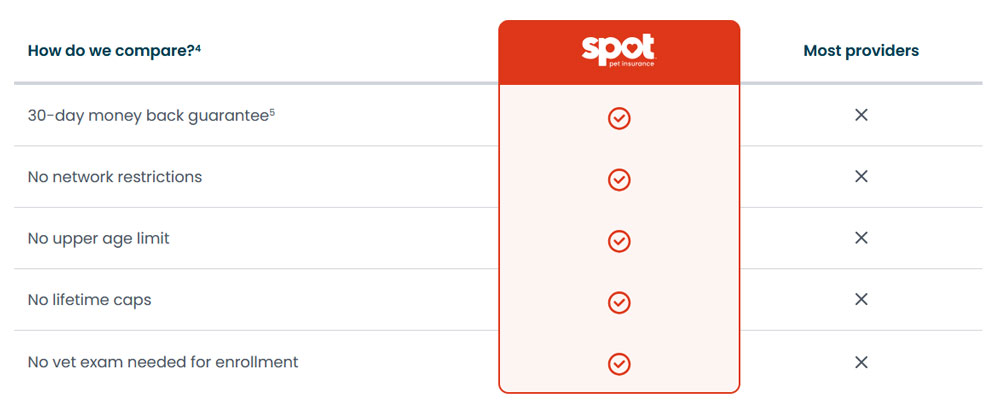
Compare before you buy coverage for your fur baby.
| Warning/Important: A lifetime cap is a silent policy killer for chronic conditions. Always verify a plan has no lifetime caps, ensuring your coverage doesn’t expire just as your aging pet needs it most. |
Feature Comparison Spot Pet Insurance vs Competitors
Comparing pet insurance plans requires more than reading marketing summaries side by side.
The features that most distinguish plans, like vet network policies, lifetime cap structures, and hereditary condition coverages, are rarely presented in a directly comparable format on provider websites.
Specific competitor plan terms should be independently verified in each provider’s current policy document before making any purchasing decision.
The comparison uses Spot’s documented plan features as the benchmark column, with the Standard Market Plan column reflecting commonly observed industry defaults.
These defaults often include network restrictions, lower reimbursement ceilings, and lifetime cap structures frequently present in plans at similar price points.
Always review policy details, as coverage, waiting periods, deductibles, and exclusions vary by state and plan.
| Feature or Metric | Spot Pet Insurance | Standard Market Plan Typical |
| Vet network policy | Any licensed vet in U.S. or Canada | Often restricted to in-network providers |
| Reimbursement rate ceiling | Up to 90% on covered vet bills | Commonly 70 to 80%; 90% less frequent |
| Hereditary condition coverage | Documented as covered | Often excluded or requires add-on |
| Dental illness coverage | Documented as covered | Frequently excluded; dental accidents only |
| Behavioral condition coverage | Documented as covered | Frequently excluded or highly limited |
| Lifetime cap structure | No lifetime caps; annual limit resets | Lifetime caps common in lower-tier plans |
| 24/7 telehealth helpline | Included as documented plan benefit | Often a paid add-on or unavailable |
| 30-day money-back guarantee | Documented; subject to policy terms | Not universally offered by competitors |
| Enrollment veterinary exam | Not required | Sometimes required prior to coverage |
| Multi-pet discount | 10% per additional pet | Varies heavily; not universally offered |
Across all ten comparison dimensions, Spot’s documented plan structure aligns with or exceeds the standard market benchmark on every marker identified as a quality indicator.
Photo from spotpet.com
Alt: Spot pet insurance coverage benefits and partner brand discounts
The most significant differentiators are the no-lifetime-cap structure, documented coverage of hereditary and dental illnesses, and the inclusion of 24/7 telehealth as a standard benefit.
Readers evaluating alternative plans should run this exact comparison using their chosen plan’s actual policy document.
| Key Insight: The most significant differentiators in pet insurance are structural: no lifetime caps, documented hereditary coverage, and included telehealth. These features provide sustainable, comprehensive protection that basic plans lack. |
7 Quality Markers Every Plan Should Pass
The seven quality markers below represent a complete pet insurance checklist built to cut through marketing language and identify plans that actually pay well at claim time.
Each marker includes a specific verification method, such as a policy section to locate, a calculation to run, or an independent source to consult.
This checklist applies equally to plans evaluated by pet owners in the United States and to those building a pet insurance buyer guide Montreal strategy.
Work through each marker in order to ensure the policy meets rigorous standards.
A plan that scores well on six but fails on the seventh, particularly concerning lifetime caps or hereditary condition exclusions, may still represent a significant financial risk. Thoroughly use the full checklist before authorizing any payments or signing agreements.
Marker 1 Through 3 Access and Reimbursement
The first practical quality marker is whether a plan allows members to visit any licensed veterinarian or restricts access to a specific network.
To verify this, locate the Eligible Providers or How to Use Your Coverage section of the policy document and confirm whether a network list is referenced.
Spot’s plan terms document any licensed vet in the United States or Canada as the standard, ensuring no penalty for choosing an out-of-network emergency clinic.
The reimbursement rate ceiling determines the maximum percentage of a covered vet bill a plan will pay back after the deductible is met.
Identify the maximum reimbursement percentage stated in the plan terms, then run a full hypothetical calculation on a representative vet bill amount.
With Spot’s documented structure of up to 90% reimbursement on covered vet bills, this calculation can be run against realistic bill amounts to avoid nasty surprises.
Verify coverage for commonly excluded condition categories: hereditary and congenital conditions, dental illnesses, and behavioral conditions.
Locate the Covered Conditions section and the Exclusions section of the policy document and check each category explicitly.
Spot’s documented plan terms name all three as covered conditions, which is the exact standard a high-quality safety net should meet.
Marker 4 Through 6 Structure and Reputation
Locate the Benefit Limits or Annual Maximum section of the policy document to check the lifetime cap structure.
Confirm whether any limit described is a lifetime maximum that permanently terminates reimbursement once reached, or an annual limit that resets at each policy renewal.
Spot’s plan terms document no lifetime caps, meaning a pet diagnosed with a chronic condition retains full annual limit access in subsequent years.
A review base of 8,300+ verified reviews provides a statistically meaningful sample for assessing real-world plan performance.
Assess recency, reviewer profiles, and specifically what reviewers say about the actual claims process to gauge true reliability.
Spot’s review volume and the consistent pattern of feedback around claims speed provide a verifiable quality signal that readers can cross-reference independently.
Pet ownership comes with costs that extend well beyond routine care. For those unexpected moments when a diagnosis changes everything, having a plan built to last matters as much as having one at all.
Pet parents who want to explore Spot Pet Insurance verified coverage for cats and dogs can review plan terms, run a personalized quote, and confirm each of these markers against actual policy documentation.
Checking whether a 24/7 veterinary telehealth helpline is included as a documented plan benefit further ensures you have support exactly when you need it.
Marker 7 Trial Period and Verification
The presence of a documented money-back guarantee removes the financial risk from the initial evaluation period.
Verify this by locating the Cancellation Policy or Money-Back Guarantee section of the policy document and confirming the specific terms.
Spot’s documented terms include a 30-day money-back guarantee available for cancellations made within 30 days of the policy’s start date, provided no covered expenses were applied.
The full seven-marker checklist is only useful if applied consistently to every plan under consideration.
Before purchasing any pet insurance plan, locate each of the seven policy sections described, run the reimbursement calculation, and independently cross-reference review volume.
The plan that scores highest across all seven markers for a Montreal pet owner is the one whose policy document confirms each feature in writing.
| Pro Tip: Use Spot’s 30-day money-back guarantee as a verification tool. Purchase the policy, review the full documentation against this guide’s quality markers, and cancel risk-free if the terms don’t match your expectations. |
What Pet Insurance Plans Typically Exclude
Understanding what is covered is only half of a complete pet insurance evaluation; the exclusions section is where the most consequential limitations reside.
The following categories represent the most common exclusions across the pet insurance market. Some are universal and apply to all plans, while others vary by provider and can be negotiated through add-ons.
Spot’s plan terms address several commonly excluded conditions, such as hereditary conditions and dental illnesses, by including them as covered conditions.
However, the categories below represent limitations that apply even to the most comprehensive plans.
Because coverage, waiting periods, deductibles, annual limits, exclusions, and pre-existing condition rules vary by plan and state, always review the fine print carefully.
Pre Existing Conditions
Pre-existing conditions are the most universal exclusion in pet insurance and apply across virtually all plans. A condition that existed or showed symptoms before the policy’s effective date is typically not eligible for coverage.
Spot’s documented plan terms include a valuable nuance; a condition that has been cured and symptom-free for 180 days may no longer be classified as pre-existing and can become eligible for coverage.
Cosmetic Procedures
Elective and cosmetic procedures, including ear cropping, tail docking, and declawing, are universally excluded from coverage under standard pet insurance plans.
These procedures are not medically necessary and fall outside the scope of accident and illness coverage. This exclusion is consistent across the market and is not a differentiating factor between plans.
Breeding and Pregnancy Costs
Costs associated with breeding, pregnancy, and whelping are excluded from standard accident and illness coverage.
Pet parents planning to breed their animals should not expect reimbursement for these costs under a standard plan.
While some wellness add-ons may cover specific reproductive health screenings, breeding costs remain broadly excluded across the industry.
Evaluating the Value of Pet Insurance
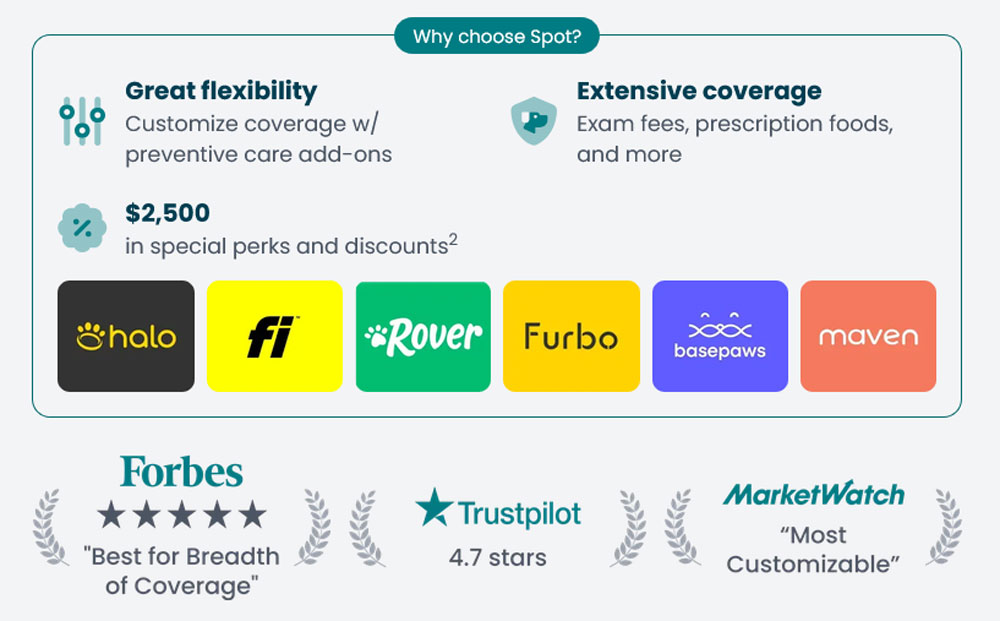
Compare your coverage for pet insurance. Look how high Spot ranks in several online trust resources.
Unexpected veterinary bills for conditions like orthopedic surgery, cancer treatment, or emergency hospitalization routinely run into thousands of dollars.
A plan that reimburses 80 to 90% of covered costs after the deductible can represent a significant net financial benefit across a pet’s lifetime, particularly for breeds with known hereditary risks.
For most pet parents, the risk of a single significant veterinary event far exceeds the annual cost of a well-structured plan, which is exactly why verifying these quality markers matters more than premium price alone.
Frequently Asked Questions
What is the difference between an annual deductible and a per condition deductible?
An annual deductible is a fixed amount a pet parent pays out of pocket each policy year before reimbursement begins.
Once the annual deductible is met across any combination of covered claims, the plan reimburses eligible costs at the selected rate for the remainder of the year. Spot’s plan terms use this highly favorable annual deductible structure.
A per-condition deductible applies separately to each distinct condition.
If a pet is treated for three different conditions in a single year, the deductible applies three times, significantly increasing out-of-pocket costs before any reimbursement is triggered. Always locate the Deductible section of the policy document to confirm the exact structure.
What does reimbursement percentage actually mean in practice?
The reimbursement percentage is the share of a covered vet bill the plan pays back after the annual deductible has been met.
At 90% reimbursement, a covered bill of $1,000, assuming the annual deductible has already been satisfied, results in a $900 reimbursement. The pet parent retains responsibility for the remaining $100.
The practical calculation always involves the covered bill amount, the remaining deductible balance, and the annual limit remaining for the policy year.
Spot’s documented reimbursement structure offers options up to 90% on covered vet bills, customizable at enrollment. Always confirm that these variables produce an acceptable real-world outcome before purchasing.
Are pre-existing conditions always permanently excluded?
In most plans, pre-existing conditions are excluded permanently for the life of the policy. However, some plans distinguish between curable and incurable pre-existing conditions.
They apply the permanent exclusion only to chronic or degenerative issues while allowing curable conditions to become eligible after a defined symptom-free period.
Spot’s documented plan terms include this important distinction. A condition that is curable, has been cured, and has been symptom-free and treatment-free for 180 days may become eligible for coverage under the plan.
Verify whether any plan under consideration includes a similar provision by locating the exact waiting period in the policy document.
Can I use my current veterinarian with any pet insurance plan?
Whether you can continue using your current veterinarian depends entirely on the vet network policy of the chosen plan.
Plans with restricted networks may require you to use approved providers, which might exclude your current vet or nearest emergency clinic. Open network policies allow you to visit any licensed professional without penalty.
Spot’s documented plan terms confirm coverage with any licensed vet in the United States or Canada, featuring no approved provider list and no referral requirements.
If keeping your current vet is a priority, verify the network policy in the Eligible Providers or How to File a Claim section of the document before purchasing.
How does the 30-day money-back guarantee work and what are the conditions?
A 30-day money-back guarantee allows a pet parent to cancel a plan within the first 30 days of the policy start date and receive a full premium refund.
For Spot’s documented guarantee, the refund is available if no covered expenses were applied to the deductible and no claims were reimbursed during that period. This structure beautifully removes the financial risk from the initial evaluation window.
To initiate a cancellation within the guarantee period, contact the provider directly and confirm the refund eligibility terms for your specific policy. Coverage, waiting periods, and refund conditions are subject to policy terms and may vary by state.
Always review the guarantee terms in the policy document itself rather than relying on a marketing summary page.